 paisley
You have stared at conjugation tables until your eyes glazed over. You have memorized the endings for passé composé, only to freeze when you need to describe what you used to do. The problem is not you. The problem is how French tenses are usually taught. They are thrown at you as a list of rules with no visual anchor. Your brain needs a map, not a dictionary.
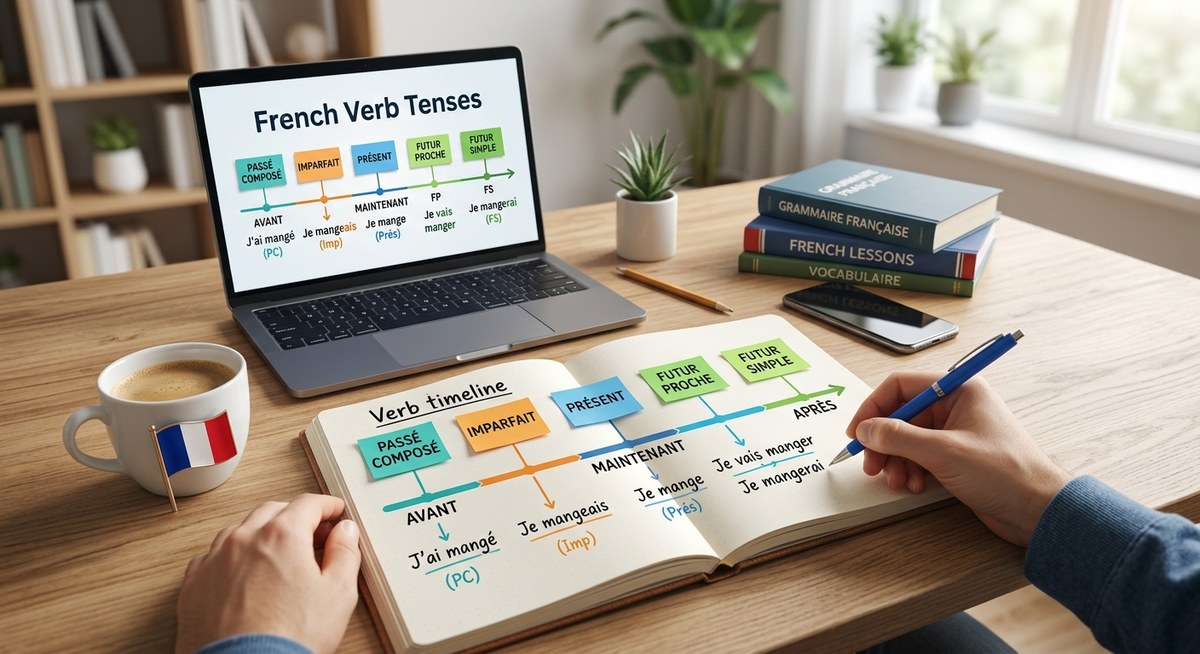
The French verb tenses timeline method gives you that map. It is a visual system that places every tense on a simple horizontal line. You see exactly where each tense sits in relation to time. Past is behind you. Present is where you stand. Future is ahead. Once you internalize this line, you stop guessing and start choosing the right tense naturally.
The French verb tenses timeline method turns abstract grammar into a visual map. You place each tense on a line: past (passé composé, imparfait, plus-que-parfait), present (présent), and future (futur simple, futur proche). This removes guesswork. Instead of memorizing rules in isolation, you see how tenses relate to each other. Apply this method for ten minutes daily, and you will choose the correct tense with confidence.
Why Your Brain Needs a Timeline
Language learning is pattern recognition. Your brain loves patterns that have a spatial component. Think about how you remember directions. You do not memorize a list of street names. You picture a route. A timeline works the same way. It gives each tense a physical location.
When you see je mangeais (I was eating), your brain places it on the left side of the line. When you see je mangerai (I will eat), your brain places it on the right. This spatial memory is stronger than rote memorization. You are not just learning endings. You are learning where each tense lives in time.
Many adult learners struggle because they try to hold all the rules in their head at once. That is like trying to read a map without knowing where north is. The timeline gives you orientation. Once you have that, everything else falls into place.
Building Your Core Timeline
Draw a horizontal line on a piece of paper. Put a dot in the middle. That dot is the present moment. Everything to the left is past. Everything to the right is future. Now you add the tenses.
The Past Section
The past side of your timeline has three main stops.
-
Imparfait goes closest to the present on the left. It describes ongoing or repeated actions in the past. Think of it as a background. Je lisais quand tu as appelé (I was reading when you called). The reading was happening. It did not have a clear end.
-
Passé composé sits a little further left. It describes completed actions with a clear beginning and end. J’ai lu le livre (I read the book). It is done. Finished. You can check it off.
-
Plus-que-parfait sits all the way on the far left. It describes an action that happened before another past action. J’avais déjà lu le livre quand tu m’as appelé (I had already read the book when you called). It is the past of the past.
Place these three on your timeline from left to right: plus-que-parfait, passé composé, imparfait, then present.
The Present Section
The present tense is your anchor. It is the dot in the middle. Je mange (I eat / I am eating). It covers actions happening now, general truths, and habits. Do not overthink this one. It is your home base.
The Future Section
The future side has two main stops.
-
Futur proche sits right next to the present on the right. It describes something that is going to happen soon. Je vais manger (I am going to eat). It is formed with aller + infinitive. It feels immediate.
-
Futur simple sits further to the right. It describes something that will happen later. Je mangerai (I will eat). It is more distant and more formal.
Place these on your timeline from left to right: present, futur proche, futur simple.
How to Practice With Your Timeline
You do not need to study for hours. You need to practice with intention. Here is a simple process that works.
-
Draw your timeline every day for one week. Use a fresh piece of paper each time. The physical act of drawing reinforces the spatial map in your brain. Label each tense with its name and a sample verb.
-
Pick one verb and move it across the timeline. Start with parler (to speak). Write je parlais on the left. Write j’ai parlé a bit further left. Write j’avais parlé on the far left. Then je parle in the middle. Then je vais parler on the near right. Then je parlerai on the far right. Say each form out loud as you write it.
-
Describe your day using the timeline. Take one event from today and place it on your timeline. Ce matin, j’ai pris mon café (passé composé). Avant cela, je m’étais réveillé (plus-que-parfait). En ce moment, je travaille (présent). Ce soir, je vais dîner (futur proche). This connects the abstract timeline to your real life.
-
Test yourself with random prompts. Ask a friend or use a flashcard app to give you a time marker. If you see hier (yesterday), point to the past section. If you see demain (tomorrow), point to the future section. If you see pendant que (while), point to imparfait. This builds reflex.
Common Mistakes and How to Fix Them
Even with a timeline, certain errors pop up again and again. Here is a table that shows the most common mistakes and the fix for each one.
| Mistake | Why It Happens | How the Timeline Fixes It |
|---|---|---|
| Using passé composé for ongoing actions | You think all past is the same | Imparfait sits closer to present. It covers background actions that were still happening. |
| Using imparfait for completed actions | You forget that some past actions are finished | Passé composé sits further left. It marks a clear endpoint. |
| Confusing futur proche and futur simple | You do not know which future to pick | Futur proche is right next to present. Use it for near future. Futur simple is further right. Use it for distant or formal future. |
| Overusing the present tense for everything | You feel safer with present | Your timeline shows that present only covers the dot. Everything else needs a different tense. |
| Forgetting plus-que-parfait | You do not think about sequencing | Plus-que-parfait is the farthest left. Use it when you need to show that one past action happened before another. |
Using the Timeline for Complex Sentences
Once you have the basic timeline down, you can start layering multiple tenses in one sentence. This is where the method really shines.
Imagine you are telling a story about last weekend.
Samedi, je me suis levé tard (passé composé). Il pleuvait (imparfait). J’ai regardé un film (passé composé). Avant le film, j’avais déjà préparé le déjeuner (plus-que-parfait). Demain, je vais raconter cette histoire à mon ami (futur proche).
Each tense has a clear spot on your timeline. You can see the order of events. The rain was happening in the background. The lunch prep happened before the movie. The storytelling will happen tomorrow. Your timeline keeps everything organized.
Expert advice: Do not try to use all the tenses at once when you speak. Start with two. Pick passé composé and imparfait. Practice telling a short story that uses both. Once that feels natural, add a third tense. The timeline is your training wheel. You will not need it forever, but it will keep you from crashing while you learn.
Integrating the Timeline Into Your Routine
Consistency matters more than intensity. Here is how to make the timeline method a daily habit.
- Morning: Draw your timeline in thirty seconds. Say the tenses out loud as you draw them.
- Midday: Pick one verb and move it across the timeline. Write it down or say it.
- Evening: Describe one event from your day using two tenses. Write it in a journal.
This takes about five minutes total. Do it for thirty days. By the end, your brain will have a strong spatial map of French tenses. You will not need to think about which tense to use. You will just know where it goes.
When the Timeline Does Not Apply
Some French tenses do not fit neatly on a simple timeline. The subjunctive mood, for example, is about emotion, doubt, or necessity. It does not have a fixed spot on the line. The conditional is about hypotheticals. It lives in a kind of imaginary space.
Do not worry about those yet. Master the main tenses first. Once you have a solid timeline for the indicative mood, you can branch out. If you want to tackle the subjunctive later, check out this guide on how to master the French subjunctive mood without losing your mind.
Your Next Step
You now have the tool. The question is whether you will use it. The French verb tenses timeline method is not complicated. It is a line on a piece of paper. But that line changes how your brain organizes information. It turns confusion into clarity.
Grab a pen and a sheet of paper. Draw your timeline right now. Put present in the middle. Put passé composé and imparfait on the left. Put futur proche and futur simple on the right. Say each tense out loud. Do this once a day for the next week.
You will be surprised how quickly your confidence grows. The tenses will stop feeling like a wall of rules. They will feel like a path you can follow. And that path leads straight to fluent, natural French.