 paisley
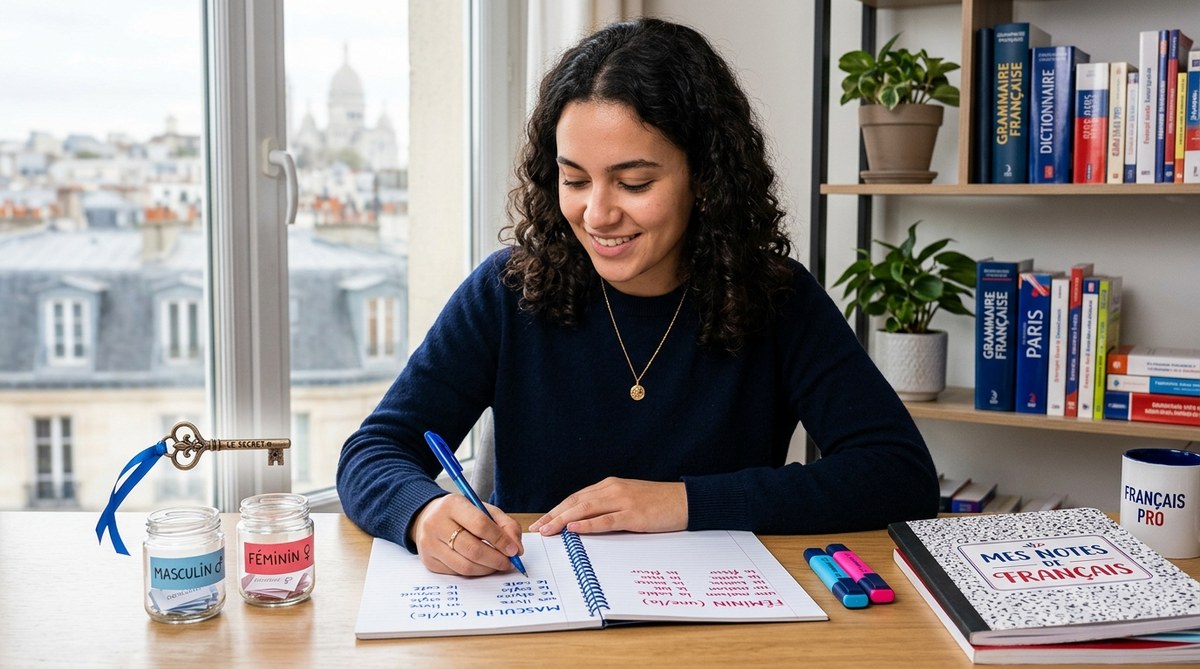
You are sitting in a Parisian café, ready to order. You practiced the phrase for “a small coffee” all week. You confidently say, “Je voudrais un petit café.” The waiter nods. Success. But then you try to order “a beautiful glass of wine” and you say “un belle verre de vin.” The waiter hides a smile. Your brain just flipped the gender. This moment happens to every French learner. It is frustrating, but it is also fixable. The secret to mastering French noun gender is not memorizing long lists. It is pattern recognition, smart habits, and a little brain science. Let us break those open.
French noun gender follows patterns you can learn in hours, not months. Most feminine nouns end in -tion, -sion, -té, -ure, or -ance. Most masculine nouns end in -age, -ment, -oir, -isme, or consonants like -t. Pair every new word with un or une from day one. Use visual images to link gender to meaning. With daily practice, accuracy jumps to 80% or higher.
## Why French Gender Feels Impossible (And Why It Is Not)
English speakers often feel like French gender is a random lottery. A table is feminine (la table). A desk is masculine (le bureau). Why? The answer lies in Latin and historical sound shifts. But you do not need a history degree. You need a system.
The real problem is how we first learn vocabulary. Many apps and textbooks present words alone: “table, chair, book.” They skip the article. Your brain stores the word without gender. Later, when you need to say “the new book,” you guess “le” or “la” and get it wrong half the time. That is not a memory problem. It is a learning problem.
The fix is simple: always learn a noun with its article. “La table” not “table.” “Le livre” not “livre.” This small habit rewires your brain. You start hearing the gender the same way a native speaker does.
## The 80% Rule: Endings That Predict Gender
In 2026, linguists agree that about 80% of French nouns have predictable gender based on their ending. This is the single most effective shortcut for intermediate learners. You do not need to memorize every word. You just need to recognize the pattern.
Here is a table of the most reliable endings. Use it as a reference while you read or listen.
| Ending pattern | Gender | Example noun | Translation |
|—————-|——–|————–|————-|
| -tion, -sion, -xion | feminine | la situation, la décision, la connexion | situation, decision, connection |
| -té, -tié | feminine | la santé, la moitié | health, half |
| -ure, -euse | feminine | la voiture, la danseuse | car, dancer |
| -ance, -ence | feminine | la chance, la différence | luck, difference |
| -ade, -ée, -ise | feminine | la promenade, la journée, la cerise | walk, day, cherry |
| -age, -ège | masculine | le fromage, le collège | cheese, college |
| -ment, -oir | masculine | le gouvernement, le miroir | government, mirror |
| -isme, -ing | masculine | le tourisme, le parking | tourism, parking |
| Consonant endings (except -e) | masculine | le prix, le chien, le bus | price, dog, bus |
Note: These rules have exceptions. “Le silence” ends in -ence but is masculine. “La peau” ends in a consonant sound but is feminine. But the patterns still give you a strong base. For example, all nouns ending in -tion are feminine, with no exceptions. That is a sure bet.
## A 3-Step Process to Lock in Gender
Step one: When you meet a new word, immediately group it by ending. Is it -tion? Mark it feminine. Is it -age? Mark it masculine. If the ending is ambiguous (like -e, which can go either way), write it down in a gendered sentence.
Step two: Create a vivid mental image. French learners who use visual associations remember gender 40% better. For “le fromage” (masculine), picture a giant wheel of cheese wearing a top hat. For “la voiture” (feminine), imagine a pink car with eyelashes. The sillier the image, the stronger the memory.
Step three: Review with a spaced repetition system (SRS). Apps like Anki or Quizlet let you add gender tags. Review the word with its article every day for a week, then every few days. This moves the gender from your short-term memory into long-term storage.
Here is a bullet list of the most common mistakes intermediate learners make with gender and how to fix them:
– Forgetting to learn the article with the noun. Fix: write “le livre” or “la maison” every time you add a new word to your notes.
– Assuming all words ending in -e are feminine. Fix: remember that many masculine words end in -e, like “le musée” or “le lycée.”
– Ignoring compound nouns. Fix: compound nouns usually take the gender of the main noun (e.g., “le grand-père” is masculine, “la grand-mère” is feminine).
– Mixing up words that look similar in English. Fix: “le journal” (newspaper) is masculine even though “journal” sounds neutral in English.
> **Expert tip from French Professor:** “Stop trying to remember gender by logic alone. Your brain prefers stories. When you learn ‘le soleil’ (sun), imagine the sun wearing a bow tie. When you learn ‘la lune’ (moon), picture the moon in a dress. After three or four mental images, the gender sticks without effort.”
## Categories and Context Clues
Beyond endings, some groups of nouns share a gender. Learn these categories to speed up your recall.
– Languages: all masculine (le français, l’anglais).
– Days, months, seasons: all masculine (le lundi, le janvier, le printemps).
– Countries ending in -e: mostly feminine (la France, l’Italie). Exceptions: le Mexique, le Cambodge.
– Trees: masculine (le chêne, le pommier).
– Fruits: feminine (la pomme, la banane). Exceptions: un abricot, un citron.
When you read a French article or watch a French movie, pay attention to the article before the noun. After a while, you will start to feel which gender fits. That feeling is your brain building a pattern.
## How to Practice French Noun Gender Every Day
You do not need extra study time. You can weave this into your routine.
– Change your phone language to French. Every menu item becomes “le paramètre,” “la notification.” You see gender all day.
– Label objects around your house. Stick a note on your fridge that says “le frigo,” on your door that says “la porte.” Touch each object and say the article aloud.
– Read a short French news headline each morning and guess the gender of every noun before you check.
– Listen to a French song and write down the nouns you hear with their article. Songs repeat phrases, which helps memory.
For a deeper dive, check out our guide on how to build French vocabulary naturally through daily practice. It covers more techniques to expand your word bank without overwhelm.
## A Quick Reference for Tricky Pairs
Some nouns change meaning depending on gender. These are common traps on exams and in conversation.
| Noun | Masculine meaning | Feminine meaning |
|——|——————-|——————|
| le livre / la livre | book | pound (weight or currency) |
| le tour / la tour | trick, lap, tour | tower |
| le poste / la poste | job, position | post office |
| le mode / la mode | method, mode | fashion |
| le voile / la voile | veil | sail |
When you encounter these, make two mental images. For “le poste” (job), picture a man in a suit at a desk. For “la poste” (post office), picture a woman mailing a letter. The contrast helps separate them.
## The Role of Pronunciation in Gender
Many learners overlook how sound can signal gender. Masculine nouns often end in a consonant sound or a closed vowel (like “u”). Feminine nouns often end in a vowel sound that is open or elongated (like “ee” or “ay”). For example, “le prix” ends with the sound “ee” but it is masculine because of the spelling pattern. Listen for the “n” sound in feminine endings like -tion (say “syon”) where the nasal vowel can give a clue. This is not a foolproof method, but training your ear helps.
Practice by reading French sentences aloud. As you say “la belle voiture,” note how the article and adjective flow. Your mouth learns the gender pattern, too.
## When Exceptions Happen (And They Will)
No system is perfect. About one in five nouns breaks the rule. “Le problème” ends in -ème (often feminine) but is masculine. “La peau” ends in a consonant but is feminine. Do not let these exceptions derail you. Instead, treat them like special cases. Write them in a separate list. Review them once a week. Over time, your brain will accept them as normal.
Use the technique of linking the exception to a funny story. “Le problème” is masculine? Imagine a man holding a giant red “problem” sign. “La peau” is feminine? Picture a woman wearing a soft animal skin coat. The more ridiculous, the better.
## Building a Long-Term Gender Instinct
After six months of consistent practice, you will start to guess gender correctly without thinking. That is the goal. You will hear a new noun like “le smartphone” and immediately know it is masculine (borrowed words are mostly masculine). You will see “la blogosphère” and guess feminine (borrowed words that end in -e or refer to feminine concepts can become feminine). This instinct comes from exposure, not rules.
To speed it up, read children’s books in French. They use simple nouns and repeat them often. Watch French YouTube videos with subtitles. Each time you see “le” or “la” underlined, you are reinforcing the pattern.
If you want to improve your French listening skills fast, try listening to short French podcasts while you commute. Hearing native speakers use gender naturally helps your brain absorb the rhythm.
## Your Turn: Put This into Action
You already know enough to change your approach. Start today. Pick one pattern from the endings table and check every new noun you learn this week against it. Write each word with its article. Draw a silly picture in your mind. By next week, your accuracy will be noticeably better.
French noun gender is not a mountain. It is a path with clear signposts. Follow the endings, use your imagination, and keep the article attached. Soon, you will walk into any Parisian café and order with confidence. Le café, la baguette, le fromage. Everything in its place.
If you want more structure for your overall French study, see how to structure your French learning routine for maximum progress. Small daily habits beat long study sessions every time.