 paisley
Getting started with French can feel overwhelming. The rules seem numerous and complex at first. But grasping some basic grammar principles makes the journey smoother. These foundational rules form the building blocks of every sentence you will learn. Once you understand them, expressing yourself in French becomes much easier. Whether you’re practicing alone or talking with native speakers, knowing these core grammar rules helps you communicate with confidence.
Mastering basic French grammar rules is essential for beginners. Focus on understanding noun genders, verb conjugations, adjective agreements, and sentence structure. These essentials will help you speak and understand French effectively from the start.
Understanding the core of French grammar for beginners
French grammar may seem intimidating at first, but most of it is logical once you learn the basics. At its heart, French grammar involves understanding how words change according to gender, number, tense, and position within sentences. Building a solid foundation in these areas makes advancing in the language much easier. This guide covers the essential rules every beginner should know to start speaking French confidently.
The fundamentals every beginner should learn
1. Gendered nouns and their articles
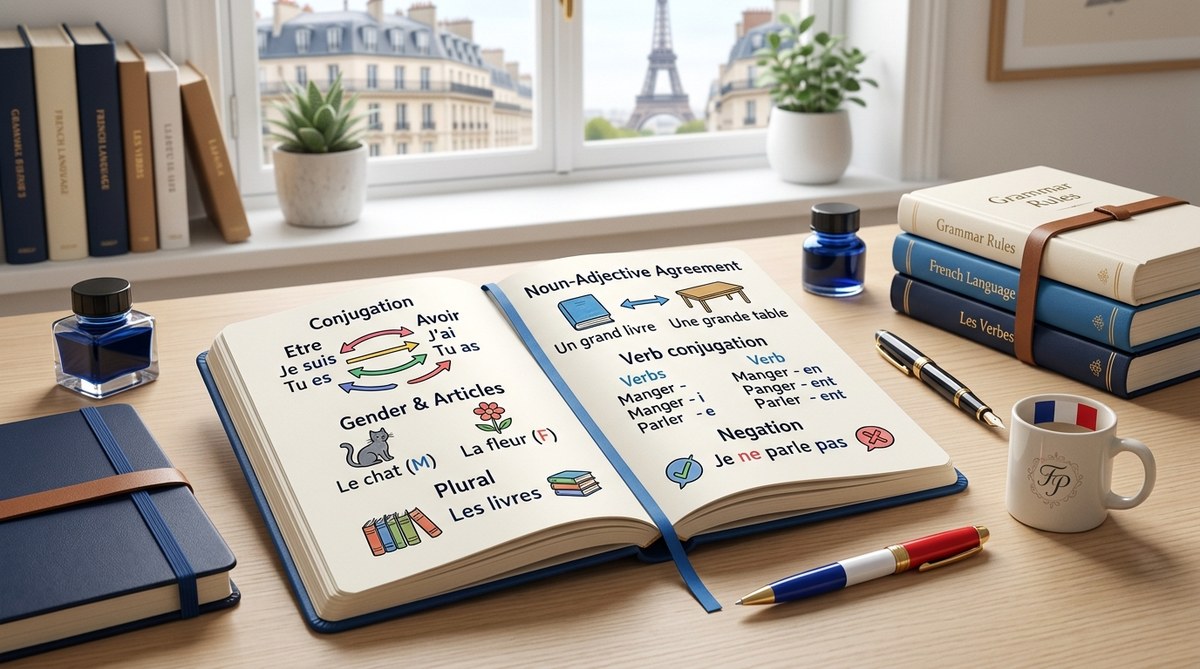
French nouns are either masculine or feminine. This gender affects the articles and adjectives used with each noun. For example, the word for “book” is masculine, so you say le livre, whereas “table” is feminine, so you say la table.
Practical tip: Always learn nouns with their definite article (le, la) or indefinite article (un, une). This helps you remember the gender naturally.
2. Agreement of adjectives with nouns
Adjectives in French must match the gender and number of the nouns they describe. For example, a big house is une grande maison (feminine), and a big car is une grande voiture.
Tip: Pay attention to adjectives ending in -e, -s, or -x, as they often change based on gender and number.
3. Verb conjugation in present tense
French verbs change form depending on the subject and tense. For beginners, focusing on the present tense forms of regular verbs (like parler, finir, vendre) is crucial. For example, je parle (I speak), tu parles (you speak), il parle (he speaks).
Quick process:
1. Identify the verb group (-er, -ir, -re)
2. Learn the present tense endings
3. Practice conjugating common verbs daily
4. Basic sentence structure
French sentences typically follow a Subject-Verb-Object pattern. For example, Je mange une pomme (I eat an apple). Understanding this order helps in forming correct sentences and making sense when speaking or writing.
5. Using negation correctly
To make a sentence negative, place ne before the verb and pas after. For example, Je ne parle pas français (I do not speak French). Remember, in spoken French, ne is often dropped, but in writing, both parts are necessary.
Techniques to learn and practice these rules
| Technique | Description | Common Mistakes |
|---|---|---|
| Memorize noun genders | Learn nouns with their articles to associate gender | Forgetting the gender when using adjectives or articles |
| Practice verb conjugations | Use flashcards or apps to drill regular and irregular forms | Confusing different verb endings in different persons |
| Use sentence templates | Create simple sentences following the SVO pattern | Mixing word order, especially with negatives or questions |
| Pay attention to agreement | Always check if adjectives match the noun’s gender and number | Overlooking agreement, leading to errors in speech or writing |
Common pitfalls and how to avoid them
| Mistake | How to fix it |
|---|---|
| Mixing gendered nouns | Always learn nouns with their definite articles |
| Forgetting irregular verb forms | Regularly review irregular verbs and their conjugations |
| Ignoring adjective agreements | Practice sentences focusing on matching adjectives to nouns |
| Misplacing negation | Practice forming negatives in different sentence types |
“Consistency in practicing core grammar rules will build your confidence. Focus on one rule at a time, and use real-life sentences to see how they fit together.” — French language expert
Practical steps to mastering French grammar as a beginner
- Start with nouns and articles. Learn the gender of common nouns and memorize their articles.
- Practice verb conjugations daily. Use apps or online exercises to build muscle memory.
- Create simple sentences. Use the basic Subject-Verb-Object structure.
- Focus on agreement. Make it a habit to check if adjectives match the nouns they describe.
- Incorporate negation. Practice turning positive sentences into negatives.
- Read and listen. Exposure to French through books, songs, or podcasts helps reinforce rules naturally.
- Speak regularly. Practice speaking with native speakers or tutors, focusing on applying grammar rules.
Visual summary of common mistakes and techniques
| Technique | Mistake | Correct approach |
|---|---|---|
| Memorize nouns with articles | Saying la livre for “book” | Learn le livre with its article |
| Practice verb endings | Confusing je parlez with je parle | Remember je parle is the correct form |
| Match adjectives | Saying une voiture grande | Use une grande voiture |
| Use negative correctly | Saying Je ne parle pas français (correct) | Avoid dropping ne in writing |
Final tips for building a strong foundation
Remember, mastering French grammar is a gradual process. Focus on understanding the core rules and practicing them in real contexts. Use resources like language apps, online exercises, or conversation groups to reinforce your learning. Over time, these rules will become second nature, and speaking French will feel more natural and enjoyable.
Embracing the journey of learning French
Grasping these foundational grammar rules opens the door to more advanced language skills. Be patient with yourself, celebrate small victories, and keep practicing. French is a beautiful language, and with consistent effort, you’ll find yourself speaking with confidence before long. Keep a positive mindset, and enjoy every step of your learning adventure.