 paisley
You have tried the verb charts. You have stared at conjugation tables until your eyes glazed over. And still, when you try to speak, the grammar slips away like sand through your fingers. This is not a sign of failure. It is a sign that your brain needs a different approach. Traditional memorization works for some things, but French grammar is not one of them. The rules are too layered, too full of exceptions, and too tied to meaning. The good news is that you can learn grammar by doing something far more natural: playing with the language.
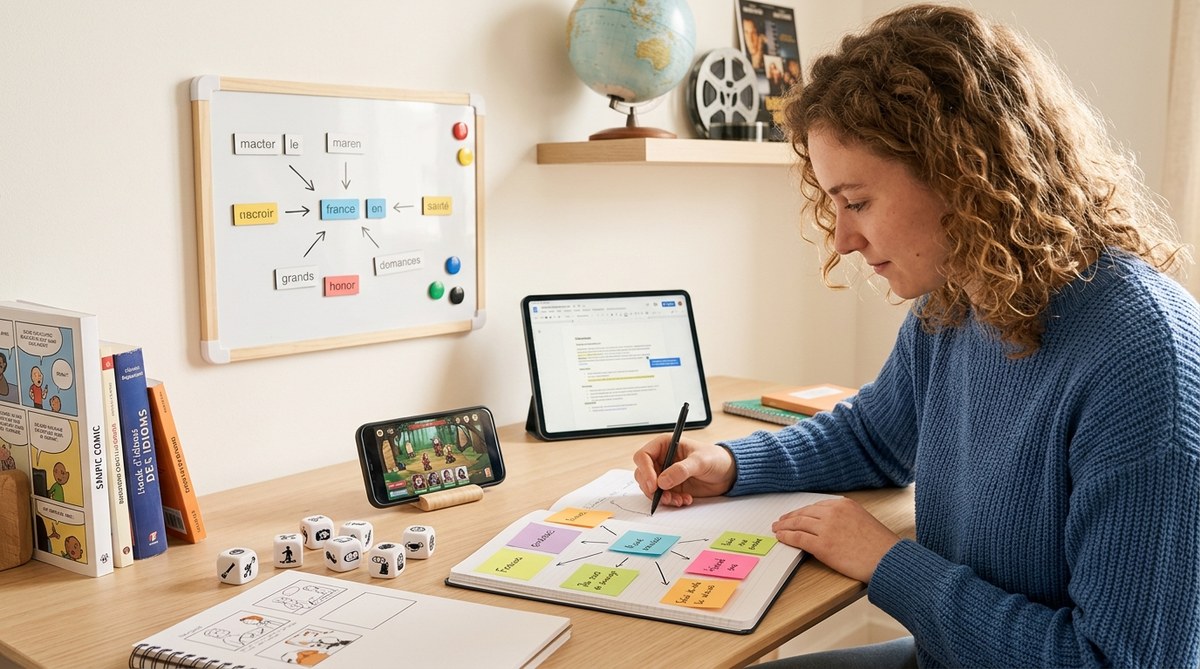
French grammar sticks when you stop treating it like a list of rules and start using it as a tool for creativity. The seven exercises in this guide replace rote memorization with storytelling, rewriting, and real-world play. Each activity targets a specific grammar challenge, from verb tenses to gendered nouns. By the end, you will have a toolkit that makes grammar practice feel like a hobby, not homework.
Why Your Brain Rejects Verb Charts
When you memorize a conjugation table, your brain stores it as a list. Lists are easy to forget. But when you use a verb to tell a story about something that actually happened to you, your brain creates a web of connections. It links the verb form to a memory, an emotion, and a context. That is why you can remember song lyrics from years ago but struggle to recall the past tense of “vouloir.”
The exercises below use this principle. They force you to make choices, to invent, and to connect grammar to meaning. You will not be drilling. You will be building.
1. The One-Sentence Story Challenge
This exercise targets verb tense usage and sentence structure. It is deceptively simple. You write a single sentence that tells a complete story. The catch is that you must use at least three different verb tenses.
Start with a basic frame. For example: “If I had known it was your birthday, I would have baked a cake, but now I am buying one at the patisserie.”
This sentence moves from the past perfect (had known), to the conditional perfect (would have baked), to the present continuous (am buying). Each tense shift carries the story forward. Your job is to create sentences that feel natural, not forced.
Try these prompts to get started:
– A moment of regret
– A surprise that changed your plans
– A decision you made this morning
– A promise for next week
Write five of these sentences each day. After a week, you will notice that your brain starts reaching for the correct tense automatically. The structure becomes instinctive because you are using it to express real ideas, not just fill blanks.
For extra practice, try writing a sentence that uses the subjunctive. If that feels intimidating, you can start with the guide on how to master the French subjunctive mood without losing your mind.
2. Rewrite Your Morning Routine in a New Tense
This exercise forces you to translate a familiar set of actions into a different grammatical time. Your morning routine is perfect because you know it by heart. You do not have to invent new content. You just have to shift the verb forms.
Write out your morning routine in the present tense. It might look like this:
- Je me réveille à sept heures.
- Je bois un café noir.
- Je prends une douche.
- Je lis les nouvelles sur mon téléphone.
- Je pars pour le travail à huit heures et demie.
Now rewrite the entire routine in the passé composé. Then rewrite it in the imparfait. Then in the futur simple. Then in the conditionnel.
Each rewrite forces you to make decisions. Do you use “je me suis réveillé” or “je me réveillais”? The choice depends on whether you are describing a completed action or a habitual one. That distinction is at the heart of the passé composé versus imparfait debate. If you struggle with this, the article on how to choose between passé composé and imparfait without confusion will help you clarify the difference.
Do this exercise three times a week. After a month, you will have internalized the patterns without ever opening a textbook.
3. The Gender Detective Game
French gendered nouns feel random. Why is “table” feminine but “sofa” masculine? There is no logical reason. But there are patterns hiding in the endings. This exercise trains your eye to spot them.
Take any French text. It could be a news article, a recipe, or a page from a novel. Go through and highlight every noun. Write it in one of two columns: masculine or feminine. After you finish, look for patterns in the endings.
Here is a table of common patterns to get you started:
| Ending | Almost Always | Example |
|---|---|---|
| -tion | Feminine | la situation, la nation |
| -sion | Feminine | la décision, la télévision |
| -age | Masculine | le fromage, le voyage |
| -ment | Masculine | le gouvernement, le sentiment |
| -eur | Masculine (for professions) | le docteur, le serveur |
| -euse | Feminine | la danseuse, la coiffeuse |
| -té | Feminine | la santé, la beauté |
| -oir | Masculine | le miroir, le devoir |
After you build your two columns, check your work against a dictionary. The patterns will start to feel automatic. Within a few weeks, you will guess the gender of new nouns with surprising accuracy.
For a deeper look at this topic, check out the guide on what’s the secret to mastering French gendered nouns.
4. Dialogue Rewriting for Subject Pronouns
Subject pronouns in French are not optional. You cannot drop them like in Spanish or Italian. But which pronoun to use can be tricky, especially when you are talking about “on” versus “nous” or “tu” versus “vous.”
Find a short dialogue from a French movie, TV show, or book. It should be no longer than ten lines. Copy it exactly. Then rewrite the entire conversation as if the speakers are different people.
For example, if the original dialogue is between two friends using “tu,” rewrite it as a conversation between a student and a professor using “vous.” Change “on” to “nous” where it makes sense. Shift “il” to “elle” if you change the gender of a speaker.
This exercise forces you to think about register and formality. It also trains you to notice when “on” is being used as a substitute for “nous” in casual speech. If you want to practice this with real-world examples, the article on explore French cultural etiquette you need to know will show you when to use each form.
5. The Adjective Placement Puzzle
French adjectives are picky about where they sit. Most go after the noun, but a handful go before. And some change meaning depending on position. “Un grand homme” is a great man. “Un homme grand” is a tall man. That is a big difference.
For this exercise, take a paragraph from any French text and remove all the adjectives. Then rewrite the paragraph, adding adjectives back in. But here is the rule: you must place at least three adjectives in the wrong position on purpose. Then correct them.
This sounds counterintuitive, but making deliberate mistakes helps you remember the correct placement. When you write “une maison blanche” as “une blanche maison,” it sounds wrong. Your brain registers the error. The next time you write it, you will feel the urge to put “blanche” after the noun.
Do this with ten sentences. Focus on the common BAGS adjectives (Beauty, Age, Goodness, Size) that go before the noun. Words like “beau,” “vieux,” “bon,” and “petit” should become automatic.
6. Sentence Scramble with a Timer
This exercise builds speed and accuracy. You will need a set of notecards or a digital equivalent. Write one word on each card. Include subjects, verbs, objects, prepositions, and adjectives. Shuffle the cards. Then set a timer for two minutes and arrange the cards into as many grammatically correct sentences as you can.
Here is a sample set of cards you might create:
– Je / Tu / Il / Elle / Nous / Vous / Ils / Elles
– mange / mangeons / mangent / bois / buvons / boivent
– du pain / de l’eau / une pomme / des croissants
– chaque matin / hier / demain / maintenant
– dans la cuisine / au parc / à l’école
The timer adds pressure. You have to make quick decisions about agreement, conjugation, and word order. After a few rounds, you will notice that your brain starts to reject incorrect combinations automatically. The scrambled words will feel wrong before you even finish placing them.
To build more advanced sets, add pronouns like “y” and “en,” or include reflexive verbs. The goal is to make the grammar feel like a reflex, not a calculation.
7. The Error Hunt in Real French Content
This is the most powerful exercise on the list because it uses authentic material. Find a French blog post, a social media caption, or a comment section on a French news site. Read it carefully and look for grammar errors. They are everywhere. Native speakers make mistakes all the time.
Keep a running list of the errors you find. Common ones include:
– Confusing “c’est” and “il est”
– Missing agreements in the past participle
– Wrong preposition after a verb
– Mixing up “ce qui” and “ce que”
After you find an error, rewrite the sentence correctly. Then write a note to yourself explaining why the original was wrong. This process trains your eye to spot patterns. Over time, you will start to see errors in your own writing before you make them.
If you want to practice this with a structured approach, the article on master common French grammar mistakes and how to avoid them provides a list of frequent errors that even advanced learners make.
A Framework for Practicing These Exercises
You do not need to do all seven exercises every day. That would be overwhelming. Instead, use this weekly framework:
- Monday: One-Sentence Story Challenge (5 sentences)
- Tuesday: Rewrite Your Morning Routine (pick a new tense)
- Wednesday: Gender Detective Game (one page of text)
- Thursday: Dialogue Rewriting (one short scene)
- Friday: Adjective Placement Puzzle (10 sentences)
- Saturday: Sentence Scramble (3 rounds with timer)
- Sunday: Error Hunt (find 5 errors in real content)
This rotation keeps things fresh. You never get bored. And each exercise reinforces the others. The storytelling from Monday feeds into the rewriting on Tuesday. The gender patterns you spot on Wednesday help you make better adjective choices on Friday.
“The best way to learn grammar is to stop thinking about grammar and start thinking about what you want to say. The rules will follow the meaning.” This advice from a French professor I once studied with has guided my own learning for years. It applies perfectly here. These exercises work because they put meaning first.
How to Track Your Progress Without Tests
You do not need a formal assessment to know if this is working. Pay attention to these signs of progress:
- You catch yourself correcting your own grammar mid-sentence.
- You read a French sentence and feel when something is “off” before you analyze why.
- You guess the gender of a new noun correctly without thinking.
- You switch between tenses in conversation without pausing to calculate.
These are real indicators that your brain has internalized the rules. They matter more than any test score.
If you want to supplement these exercises with a structured routine, the guide on how to structure your French learning routine for maximum progress will help you build a schedule that fits your life.
Grammar as a Creative Act
French grammar is not a prison. It is a set of tools that let you say exactly what you mean. When you learn it through creative exercises, you are not just memorizing rules. You are building the ability to express nuance, humor, and emotion. That is the real goal of language learning.
Start with the exercise that sounds most fun to you. Do it for five minutes today. Then do it again tomorrow. The grammar will come. Not because you forced it, but because you gave your brain a reason to remember.