 paisley
Learning French as an American comes with its own set of challenges. Your brain wants to default to English logic, and French often works differently. That is completely normal. The good news is that most of these errors are predictable, which means they are also fixable. Over the years teaching American students, I have noticed the same patterns again and again. This guide breaks down the eight most frequent mistakes and gives you concrete ways to correct them. By the end, you will feel more confident and sound much more natural when you speak.
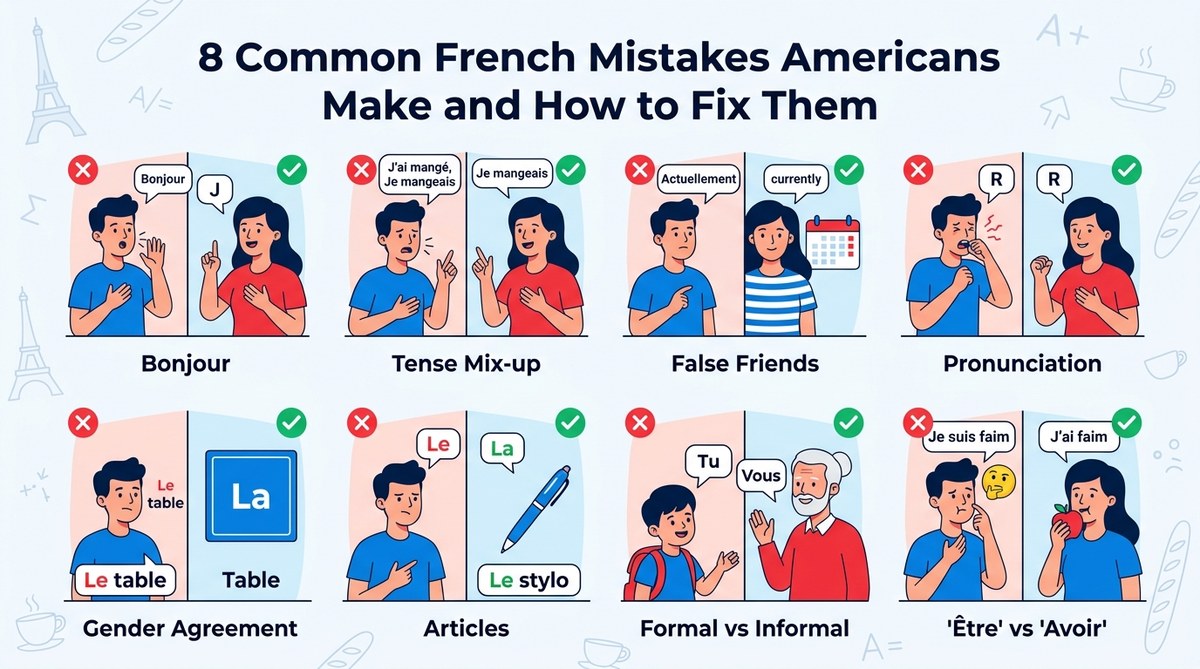
American learners often stumble on false cognates, gendered nouns, word order, and pronunciation. Each mistake has a clear cause and an even clearer fix. Focus on one error at a time, practice out loud, and use the memory tricks provided. Within a few weeks, these eight corrections will dramatically improve your fluency and help you avoid awkward misunderstandings with native speakers.
Running Into Fake Friends: The Faux Amis Trap
One of the biggest hurdles for English speakers is the false cognate, or faux ami. These are words that look the same in English and French but have different meanings. A classic example is actuellement. An American might say, “Actuellement, je suis fatigué” thinking it means “Actually, I am tired.” In reality, actuellement means “currently” or “at the moment.” The correct word for “actually” is en fait. Another common one is sensible, which in French means “sensitive,” not “sensible” (that would be raisonnable). To fix this, memorize the most frequent false cognates using flashcards. I recommend making a list of ten and reviewing them daily until they become automatic.
Here are a few more to watch out for:
- Attendre does not mean “attend”; it means “to wait.”
- Assister à means “to attend,” not “to assist” (that is aider).
- Librairie is a bookshop, not a library (that is bibliothèque).
Gender Confusion: Le or La
Every French noun has a gender, and English speakers often forget to learn it along with the word. This leads to mistakes like “le table” instead of “la table.” The fix is simple: always memorize the noun with its article. Do not just learn “chaise”; learn “une chaise.” Use color coding in your notes, blue for masculine and pink for feminine. There are also helpful patterns. Words ending in -tion or -sion are almost always feminine. Words ending in -age (like voyage) are usually masculine. The more you practice, the more intuitive it becomes. For a deeper breakdown, check out how to master French gendered nouns.
Skipping Liaison When You Shouldn’t
French pronunciation is tricky because of liaison, the rule where a normally silent consonant at the end of a word is pronounced when the next word starts with a vowel. Americans often skip these sounds, making their speech choppy. For example, “les étudiants” should sound like “lay zay too dee ahn,” not “lay ay too dee ahn.” The “s” in les links to étudiants with a Z sound. A good way to practice is to read sentences out loud and underline the linking letters. Start with the most common ones: les, des, ces, un, mon, ton, son before a vowel. For more tips, see our guide on understanding French liaison for natural speech.
The Tu vs. Vous Confusion
Americans tend to default to tu because it feels friendly and informal. But French culture places a high value on formality. Using tu with a stranger, your boss, or an elderly person can come across as rude. The rule of thumb: use vous with anyone you do not know well, anyone older, or in a professional setting. Use tu only with close friends, family, and children. If you are unsure, start with vous. It is safer and shows respect. Once the other person invites you to use tu, you can switch. This is a small change that makes a big difference in how you are perceived. Related to this is French cultural etiquette you need to know, which covers more social nuances.
Overusing the Present Tense When You Need the Past
Another common mistake is relying too heavily on the present tense or using the passé composé incorrectly. For instance, saying “Je suis allé au cinéma hier” is correct for a single event. But many Americans use it for repeated past actions too. The imparfait is for ongoing or habitual past actions: “Quand j’étais jeune, j’allais souvent au cinéma.” The best way to get this right is to ask yourself: “Is this a one-time action with a clear start and end?” If yes, use passé composé. If it describes a scene, a habit, or an ongoing state, use imparfait. For detailed practice, see how to choose between passé composé and imparfait.
Misplacing Pronouns in Sentences
English word order is subject-verb-object. French sometimes places object pronouns before the verb, which feels backward to Americans. For example, “I see him” is “Je le vois,” not “Je vois lui.” The pronoun le goes directly before the verb. Similarly, “I speak to her” becomes “Je lui parle.” This takes practice. Make a table of the common object pronouns and their positions.
| English Pronoun | French Direct Object | French Indirect Object |
|---|---|---|
| me | me | me |
| you (informal) | te | te |
| him/it | le | lui |
| her/it | la | lui |
| us | nous | nous |
| you (formal) | vous | vous |
| them | les | leur |
Practice by rewriting sentences from English to French, moving the pronoun before the verb. This is a key part of mastering common French verb conjugations for beginners because pronouns and verbs work together.
Translating Word for Word: The Literal Trap
Americans often translate English idioms directly into French, which results in nonsense. For example, “I miss you” is not “Je manque toi.” It is “Tu me manques.” Literally, “You are missing to me.” Another example: “I am 20 years old” is “J’ai 20 ans” (I have 20 years), not “Je suis 20 ans.” The solution is to learn phrases as whole units. Instead of translating “I am hungry,” learn “J’ai faim.” Internalize the pattern: French uses avoir (to have) for many expressions where English uses to be. This includes age, hunger, thirst, and temperature. A great way to absorb these is through listening to French songs where these phrases appear naturally.
Pronouncing Silent Letters and Overcorrecting
French is famous for silent letters. Americans either pronounce them (saying the “t” at the end of petit) or they overcorrect and drop sounds that should be pronounced, like the “s” in plus when it means “more.” Here is the general rule: final consonants are usually silent, except for C, R, F, L (think CaReFuL). But there are exceptions, especially in liaison. A safe strategy is to learn pronunciation patterns for common word endings. For example, -ent at the end of a verb (like parlent) is silent. -er at the end of a verb sounds like “ay.” Use a pronunciation guide. For targeted help, see unlock the secrets of French pronunciation.
“The biggest leap in fluency happens when you stop translating every word and start thinking in blocks of meaning. Focus on one mistake at a time. Your brain will rewire faster than you think.” — Anne, French language coach
A Practical Plan to Fix These Mistakes
Instead of trying to fix everything at once, follow this numbered process:
- Identify your top three mistakes. Write down which errors you make most often. For example, if you keep mixing up tu and vous, that is number one.
- Create a focused practice session of 10 minutes per day. Spend the time on just that mistake. Use flashcards, repeat sentences out loud, or listen for that mistake in a podcast.
- Get real feedback. Ask a native speaker or use a language exchange app to correct you. If that is not possible, record yourself and compare with a native audio.
- Keep a mistake journal. Note the error, the correct form, and why you made it. Review it weekly.
- Celebrate small wins. When you catch yourself correcting a mistake mid-sentence, that is progress.
Putting It All Together in 2026
Learning a language is a journey. The common French mistakes Americans make are not signs of failure; they are stepping stones. Every time you catch a false cognate or remember to use vous with a stranger, you are building a stronger foundation. In 2026, with so many online resources and tools, you have everything you need to succeed. The key is consistency and a willingness to laugh at your own slip ups. French people appreciate the effort, even when you get it wrong. Keep practicing, and soon these eight fixes will become second nature. You have got this.