 paisley
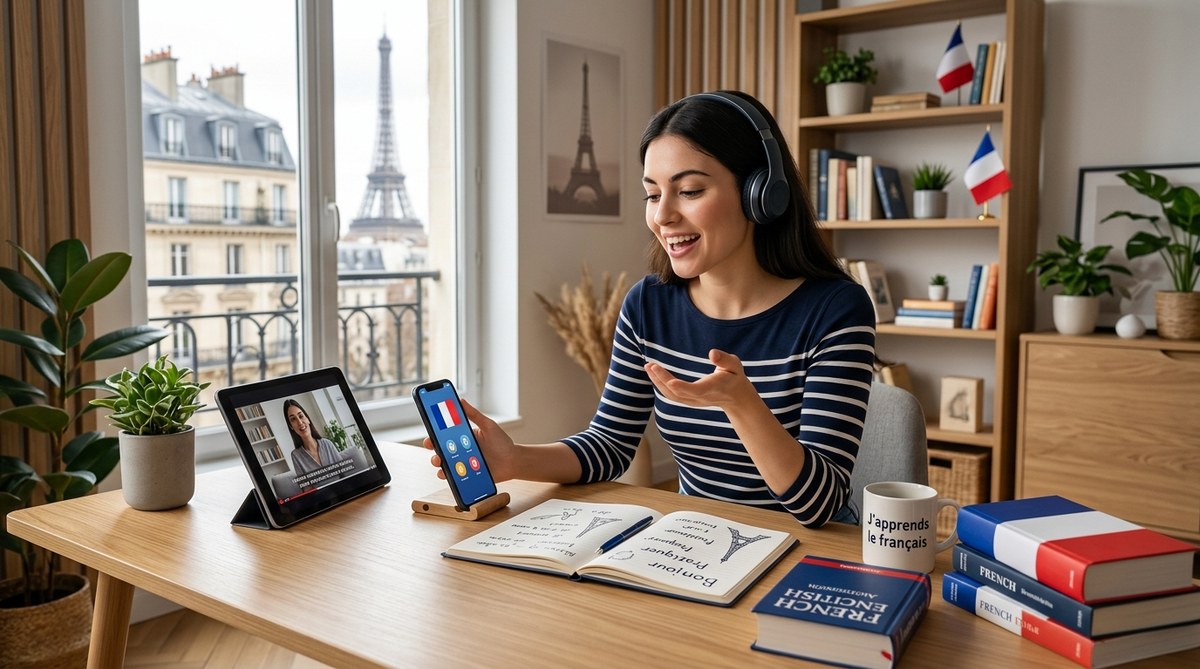
You have the motivation and the vocabulary lists. You can read French news articles and understand most of a Netflix show. But when it comes to opening your mouth and forming a sentence out loud, your brain freezes. You know you need to speak more, yet you don’t have a tutor, a conversation partner, or a French club nearby. Does that mean you are stuck? Not at all. Thousands of intermediate learners have built fluent speaking habits entirely on their own, and you can too. The key is to stop waiting for a partner and start using the resources you already have: your voice, your ears, and a little bit of daily structure.
You do not need a tutor to improve your spoken French. Solo methods such as shadowing, self-talk, reading aloud, and recording yourself train your articulation, intonation, and fluency. The most effective approach combines passive listening with active repetition. By dedicating 15–20 minutes daily to structured practice, you can build muscle memory for real conversations — no partner required.
Why Speaking Practice Still Works Without a Partner
When you practice speaking alone, you are not just talking to the wall. You are training the neural pathways that control pronunciation, rhythm, and sentence assembly. Research in second language acquisition shows that self-directed speech practice activates the same motor and auditory areas as real conversation. The difference is that you can go at your own pace, repeat tricky sounds endlessly, and correct your mistakes without pressure.
Think of it as a rehearsal. A musician practices scales alone before a concert. A chef chops onions alone before service. Speaking a language is no different. By creating a low stress environment where you can stumble and try again, you build confidence that carries over into real interactions.
5 Solo Methods That Work
- Shadowing – Play a short audio clip of a native French speaker and repeat it aloud in real time, mimicking the intonation and rhythm. Start with slow speech, then increase speed.
- Self-talk – Narrate your day in French. While washing dishes, describe what you are doing: “Je prends l’éponge et je frotte l’assiette.” It feels strange at first, but it forces you to form sentences quickly.
- Reading aloud – Pick a French article or a page from a novel and read it out loud. Focus on clear pronunciation and natural pacing, not speed.
- Recording and playback – Record yourself answering a simple prompt (e.g., “Qu’est-ce que tu as fait hier ?”). Listen to the recording and note one sound or phrase to improve. Then record again.
- Delayed repetition – Listen to a sentence, pause, think about what you heard, and then say it from memory. This builds recall and fluency more than straight repeating.
Techniques vs. Common Mistakes: A Comparison Table
| Technique | What It Does Well | Common Mistake to Avoid |
|---|---|---|
| Shadowing | Improves accent and rhythm | Trying to shadow fast audio before mastering slower clips |
| Self-talk | Builds spontaneous sentence formation | Translating from English instead of thinking in French |
| Reading aloud | Reinforces pronunciation and linking | Rushing through words without paying attention to liaison |
| Recording yourself | Reveals blind spots in pronunciation | Never listening back to the recording |
| Delayed repetition | Strengthens auditory memory and word order | Waiting too long between hearing and repeating (keep it under 3 seconds) |
Expert advice from a French phonetics teacher: “The biggest leap my students make is when they stop worrying about being perfect and start making mistakes on purpose in a safe environment. If you mispronounce a word while recording, leave it there and try again. Your brain learns from the contrast between the error and the correction.”
How to Structure a 20 Minute Solo Speaking Session
You do not need hours of free time. Consistency beats volume every time. Here is a simple routine you can do during your morning coffee or before bed.
- Minutes 1–5: warm up. Say the French vowel sounds out loud. “A, E, I, O, U, Y” with exaggerated mouth movements. Stretch your lips for “u” and “ou”.
- Minutes 6–10: shadow a short audio. Use a 1 minute clip from a podcast or a news report. Play it three times: first just listen, then shadow at half speed, then shadow at normal speed.
- Minutes 11–15: read a paragraph aloud. Choose a text that matches your level. Read it once silently, then read it aloud twice. On the second reading, focus on your weakest sounds (often the French R or nasal vowels).
- Minutes 16–20: record yourself answering a question. Pick a question like “Quel est ton film préféré ?” Answer in 3–4 sentences. Listen back and pick one word that sounded off. Say it correctly five times.
This routine works because it mixes input, repetition, and self evaluation. After two weeks, you will notice that your mouth moves more naturally, and you hesitate less.
What to Avoid When Practicing Alone
- Avoid translating everything. When you read aloud, try to visualize the meaning instead of silently translating to English. That mental shift helps you speak more fluidly.
- Avoid mumbling. It is tempting to whisper or speak softly when no one is listening, but that trains weak articulation. Speak at a normal volume, as if someone were three feet away.
- Avoid the same material every day. Your brain adapts quickly. Rotate between news, dialogues, songs, and descriptive texts. This variety forces your speech muscles to handle different contexts.
- Avoid perfectionism. You will stumble over liaisons and nasal vowels. That is normal. The goal is not flawless speech in week one; the goal is to build the habit. Each attempt strengthens the circuit.
Your Solo French Speaking Journey Starts Today
If you have been waiting for the perfect tutor or a fluent friend to appear, let this article be your permission to start alone. The methods described here work because they are active, structured, and repeatable. You can integrate them into your current routine without any extra cost or scheduling.
Pair your speaking practice with resources that support your growth. For example, improving your listening will make shadowing easier, so check out our guide on effective strategies to improve your French listening skills fast. Pronunciation obstacles are common; if the French R or nasal vowels trip you up, unlock the secrets of French pronunciation for confident speaking. And to keep your vocabulary fresh, read our tips on how to build French vocabulary naturally through daily practice.
You have everything you need right now. A voice. A device to record. A few minutes a day. Start today with one method: shadow a single sentence. Repeat it until it feels easy. Then add another. Before you know it, you will be having real conversations in your head and, later, out loud with others. The path to fluency is paved with small, solo steps. Take the first one now.