 paisley
You sit down to study French. You open a app, scroll through a grammar page, watch half a video, then close everything feeling like you barely moved forward. This is not a motivation problem. It is a structure problem. Without a clear French learning routine, your brain does not know which skill to practice when. You end up doing a little of everything and mastering nothing. The good news? A well designed routine can turn scattered effort into steady progress. You just need a plan that respects your time, targets your weak spots, and keeps you coming back tomorrow.
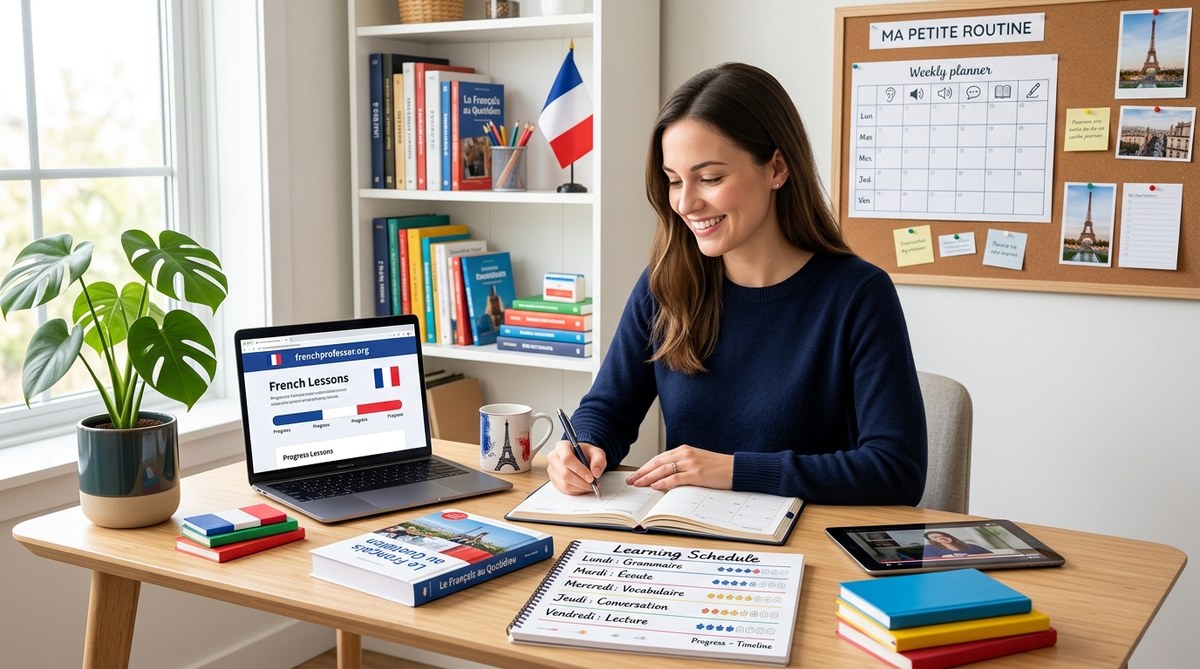
An effective French learning routine balances four core skills: listening, speaking, reading, and writing. Short daily sessions of 20 to 30 minutes beat long weekly marathons. Focus one skill per day, use active recall to lock in vocabulary, and adjust your plan every month as you improve. Consistency, not intensity, creates fluency.
Why Your French Practice Needs a Schedule
Learning French without a routine is like driving across the country without a map. You might eventually arrive, but you will waste a lot of fuel and time along the way. A structured plan turns your scattered efforts into a focused system.
When you decide your study time in advance, you stop losing energy deciding what to do. Your brain already knows that Tuesday morning means listening practice. Thursday evening means speaking drills. This automation conserves willpower and makes it easier to show up every day.
A consistent routine also helps your memory. Language learning relies on spaced repetition. You need to see a word or grammar rule again after one day, then after three days, then after a week. A schedule ensures those reviews actually happen.
“The best routine is the one you actually follow. Do not aim for perfection. Aim for presence. Fifteen minutes of focused French every day will outperform two hours once a week every time.” — Language acquisition research principle, adapted from Dr. Paul Pimsleur
The Four Pillars of a Balanced French Learning Routine
To build a complete routine, you need to practice each of the four language skills. Neglecting one creates a gap that slows everything else down.
Here is the framework I recommend. Each day of your week targets one primary skill while weaving in review from previous days.
- Listening day Train your ear with native content. Use podcasts, YouTube channels, or French radio. Do not worry if you only catch 30 percent at first. Your brain is mapping the sounds.
- Speaking day Practice output. Talk to yourself in the mirror, record voice memos, or use a language exchange app. The goal is to form sentences without translating from English.
- Reading day Read French texts at your level. News sites, graded readers, or even food packaging. Look up a few key words but focus on understanding the gist.
- Writing day Write a short paragraph about your day, a description of a photo, or a response to a prompt. Use a tool like LangCorrect or just a notebook.
You can rotate these four across a four day cycle and then repeat. Or you can assign specific weekdays. Find what fits your schedule.
A Note on Grammar and Vocabulary
Some learners think grammar and vocabulary are separate subjects. They are not. You should weave them into your skill days. On listening day, note a new verb form you hear. On writing day, look up the gender of a noun you keep forgetting. This contextual learning sticks far better than isolated drills.
If you want to build a stronger foundation, check out our guide on master-common-french-verb-conjugations-for-beginners. It pairs perfectly with a speaking day routine.
Sample French Learning Routines for Different Schedules
Not everyone has the same time budget. Below are three sample routines. Pick the one that matches your availability and adjust as needed.
| Time Available | Daily Plan | Weekly Focus |
|---|---|---|
| 15 minutes per day | One skill per day. Monday: listen to a 10 minute podcast + 5 minute recap. Tuesday: repeat a short dialogue out loud. Wednesday: read one news headline and look up 3 words. Thursday: write 3 sentences about your day. Friday: review vocabulary from the week. | Build a habit first. Speed comes later. |
| 30 minutes per day | 10 minutes of active recall (flashcards or writing from memory), 15 minutes of skill work (rotate listening, speaking, reading, writing), 5 minutes of free form input (watch a short clip or scroll French social media). | Develop comfort with all four skills. Push yourself to speak without preparation. |
| 60 minutes per day | 15 minutes of deep grammar study or verb drills, 30 minutes of mixed skill work (listen to a dialogue then answer questions out loud), 15 minutes of extended reading or writing. | Focus on weak spots. Record yourself speaking and compare to a native model. |
No matter which schedule you choose, keep a notebook or digital document where you track what you studied each day. This small act of reflection reinforces learning and shows you exactly where you improved.
Common Mistakes That Derail a French Learning Routine
Even the best plan can fail if you fall into these traps.
- Skipping review days New information fades quickly. If you only move forward and never circle back, you will forget more than you learn.
- Staying in your comfort zone If you always read easy texts and listen to slow audio, your growth will stall. Push yourself with content slightly above your current level.
- Ignoring pronunciation early Bad habits are hard to break. Spend time on sounds from the beginning. Our resource on unlock-the-secrets-of-french-pronunciation-for-confident-speaking can help you correct common errors before they become permanent.
- Comparing your routine to others A friend might study two hours a day. That does not mean you need to. Work with the time you have, not the time you wish you had.
- Neglecting listening comprehension Many learners focus heavily on reading and grammar but avoid listening because it feels hard. This creates a gap where you can understand written French but freeze during a real conversation. Learn more about effective-strategies-to-improve-your-french-listening-skills-fast.
How to Stay Consistent Without Burning Out
Consistency is the engine of progress. But life gets busy. You travel for work. You get sick. You have a hectic week. What then?
First, lower the bar. On days when you have zero energy, do just five minutes. Listen to one French song. Read one Instagram caption. The act of showing up, even briefly, keeps the habit alive.
Second, use habit stacking. Attach your French practice to something you already do every day. Listen to a French podcast while making coffee. Review flashcards during your lunch break. Write a journal entry right before brushing your teeth.
Third, vary your materials. Doing the same thing every day leads to boredom. Swap between resources. One week you might use news articles. The next week you might try a French graphic novel. Our list of discover-effective-french-study-resources-for-beginners offers fresh ideas you can rotate into your routine.
Fourth, celebrate small wins. Finished a chapter without looking up every word? Understood a full song lyric? That is real progress. Acknowledge it.
The Role of Culture in Your Daily Practice
Language and culture are inseparable. When you learn about French customs, food, and traditions, you give your brain more hooks to hang vocabulary on. A word like “boulangerie” becomes easier to remember when you picture the warm light of a neighborhood bakery at 7 AM.
Try to weave cultural elements into your routine naturally. On reading day, look up a French recipe and try cooking it. On listening day, watch a French film trailer. On speaking day, practice ordering a meal or asking for directions as if you were in Paris. This makes your practice feel alive.
You can start with our guide on explore-french-cultural-etiquette-you-need-to-know to understand social norms that shape everyday conversations.
Building Your French Learning Routine Step by Step
Let me walk you through the exact process I recommend.
- Assess your current level honestly Can you introduce yourself? Can you order food? Can you understand a slow news broadcast? Write down what you can and cannot do.
- Set one clear goal for the next month Example: “I want to hold a 3 minute conversation about my weekend.” or “I want to read a short news article without stopping to translate every word.”
- Choose your time slot Pick a consistent time of day. Morning works well because your mind is fresh and you have not yet used up your decision energy.
- Build your weekly skill rotation Use the table above to decide which skill gets which day. Write it on a calendar or set a recurring reminder on your phone.
- Prepare your materials in advance Do not waste your study time searching for resources. On Sunday evening, bookmark 4 podcasts, print a short article, and write down a few speaking prompts.
- Review and adjust every four weeks Your routine should evolve as you improve. If speaking feels easy now, add more challenging prompts. If listening still feels hard, double your exposure.
If grammar is a weak spot, spend a few sessions on essential-french-grammar-rules-every-beginner-should-know. It will give you the structure you need to build correct sentences.
A Final Word on Making This Stick
You now have everything you need to build a French learning routine that actually works. The key is to start small, stay consistent, and keep adjusting as you grow.
Do not wait for the perfect plan. Pick one routine from this article and follow it for two weeks. At the end of those two weeks, ask yourself what felt good and what felt hard. Then tweak your approach.
Every minute you spend with French, even the messy ones, moves you closer to fluency. So open your notebook. Set your timer. Start your routine today. You will thank yourself a month from now when you understand a conversation that used to sound like gibberish.