 paisley
You want to speak French out loud. You have the vocabulary lists. You understand written sentences okay. But when it is time to actually form words with your mouth, your brain freezes. You have no native speaker to talk to. No conversation partner. Just you and your textbook.
That is a common problem. And it is solvable.
Speaking a language is a physical skill, like learning to throw a baseball or play a chord on a guitar. You need reps. You need to train your mouth, your ears, and your brain to work together in real time. You do not need another person to do that. You just need the right methods.
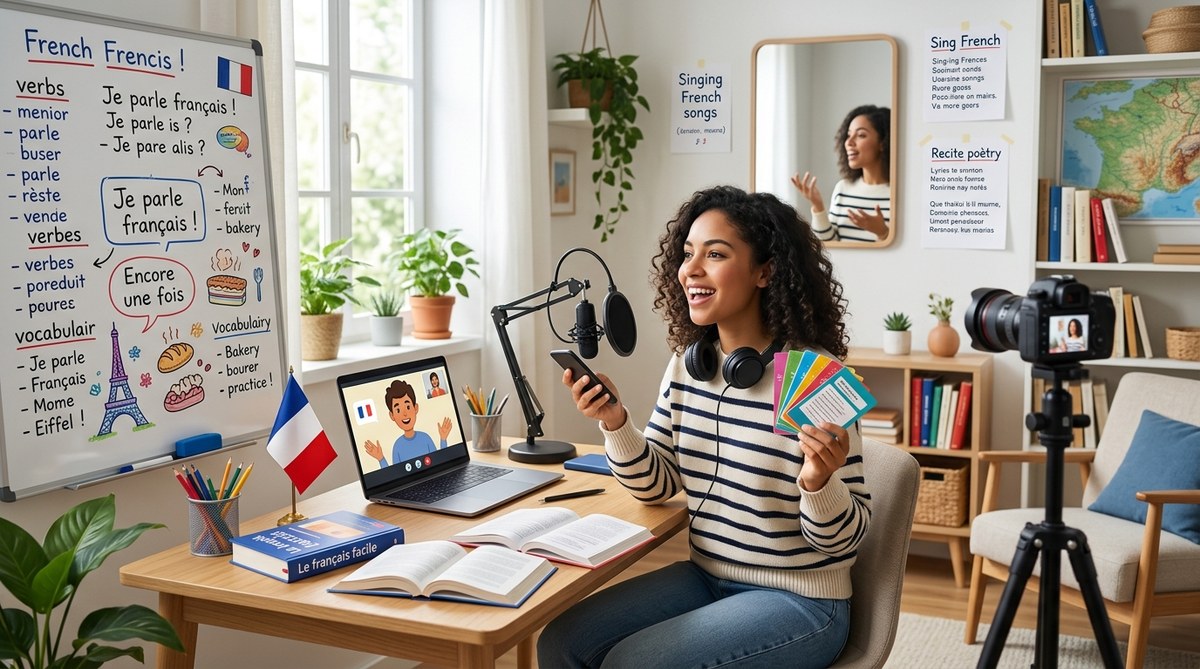
This guide gives you seven creative ways to practice French speaking alone. These are not abstract theories. These are daily actions you can start this afternoon.
You do not need a conversation partner to improve your spoken French. The seven methods in this article train your mouth, ears, and brain to work together. Each technique builds real fluency through self-talk, imitation, and structured repetition. Pick one method today and practice for ten minutes. Your speaking skills will grow faster than you expect.
Why Speaking Alone Feels Awkward (And Why That Is Normal)
Your brain has two language pathways. One is passive recognition. That is reading and listening. The other is active production. That is speaking and writing.
Most self-directed learners spend 80 percent of their time on passive work. They read articles. They listen to podcasts. They watch YouTube videos. Their passive vocabulary grows large. Their active vocabulary stays small.
When you try to speak, your brain has to retrieve words from memory, organize them into correct grammar, and control your tongue and lips. That is a lot of processing. It feels slow and clumsy. That feeling is not failure. It is the beginning of growth.
The only way to strengthen the active pathway is to use it. Repeatedly. Without judgment. These seven methods are designed to do exactly that.
The Seven Creative Methods
1. The Self-Interview
Set a timer for three minutes. Ask yourself a simple question in French. Then answer it out loud. Record yourself on your phone.
Start with easy questions. “What did I eat for breakfast?” “What is the weather like outside?” “What color is my shirt?”
The goal is not perfect grammar. The goal is to keep your mouth moving in French for the full three minutes. If you get stuck, use a filler word like “euh” (the French equivalent of “um”) and keep going.
After you finish, listen to the recording. You will hear mistakes. That is the point. Your ears will start to notice problems that your brain can fix next time.
2. Shadowing with a French Audio Clip
Shadowing means you listen to a short audio clip and repeat it out loud at the same time. You mimic the speaker’s rhythm, intonation, and pronunciation.
Pick a clip that is 30 to 60 seconds long. A news report, a dialogue from a movie, or a language lesson works well. Play it on headphones. Speak along with the speaker. Do not pause the audio. Just follow.
This method trains your ear to hear French sounds and your mouth to produce them simultaneously. It builds speed and natural rhythm.
For best results, choose audio that is slightly above your current level. You want to stretch your ear, not just confirm what you already know. You can find good audio clips on French news sites or in the listening exercises of your textbook.
3. Describe Your Environment
Look around the room you are sitting in. Describe everything you see in French. Out loud.
Start with nouns. “There is a window. There is a chair. There is a lamp.” Then add adjectives. “The window is large. The chair is blue. The lamp is old.” Then add action. “I am sitting on the chair. I am reading a book.”
This forces your brain to connect French words to real objects and actions. It is not abstract. It is direct. You are building a bridge between your environment and your second language.
If you do not know a word, look it up. Say it three times. Then move on. Your vocabulary will grow naturally because you are learning words you actually need.
4. The 10-Minute Monologue
Pick a topic you care about. Sports, cooking, your job, a movie you just watched. Set a timer for ten minutes. Talk about that topic in French without stopping.
You can pause. You can repeat yourself. You can start a sentence over. But you cannot switch to English.
This is hard. It is supposed to be hard. The first time you try, you might last 45 seconds. That is fine. Next time, aim for one minute. Then two. Then five.
The monologue trains your brain to sustain output. It builds stamina. It also reveals exactly where your vocabulary gaps are. Write down the words you needed but did not know. Learn them. Try the same topic again tomorrow.
5. Read Aloud with Intention
Take a French text. A news article, a short story, or a paragraph from a novel. Read it out loud.
But do not just read the words. Act them. If the text is a dialogue, use a different voice for each character. If the text is a news report, sound like a news anchor. If the text is a love letter, sound romantic.
This method trains your mouth to produce French sounds in a natural, flowing way. It also forces you to pay attention to liaison, elision, and intonation patterns that silent reading ignores.
For extra benefit, record yourself reading the same passage three times. Listen to the first recording. Notice where you stumble. Practice those phrases. Then record again. You will hear improvement in real time.
6. The Question-and-Answer Game
Make a list of 20 common French questions. “What is your name?” “Where do you live?” “What do you do for work?” “What are your hobbies?” “What did you do yesterday?” “What will you do tomorrow?”
Pick one question. Answer it out loud. Then ask yourself a follow-up question based on your answer. Keep the conversation going as long as you can.
For example:
Question: “What did you do yesterday?”
Answer: “I went to the park.”
Follow-up: “What did you see at the park?”
Answer: “I saw a dog and a child.”
Follow-up: “What color was the dog?”
Answer: “The dog was brown.”
This mimics a real conversation. It trains your brain to listen to its own output and respond to it. That is exactly what you do when you talk to another person.
7. The French Voice Diary
Record a daily voice diary in French. Talk about your day. Your feelings. Your plans. Keep each entry between one and three minutes.
Do not write a script. Just speak. Let the words come out naturally. If you make a mistake, do not stop. Keep going.
After a week, listen to your first entry and your latest entry. You will hear progress. Your sentences will be longer. Your pauses will be shorter. Your pronunciation will be clearer.
This method is powerful because it combines self-expression with language practice. You are not just learning French. You are living in French.
A Simple Weekly Routine
You do not need to use all seven methods every day. That would be overwhelming. Instead, build a simple weekly routine.
- Monday: Self-interview (5 minutes)
- Tuesday: Shadowing (10 minutes)
- Wednesday: Describe your environment (5 minutes)
- Thursday: 10-minute monologue
- Friday: Read aloud (10 minutes)
- Saturday: Question-and-answer game (10 minutes)
- Sunday: French voice diary (5 minutes)
Total time per week: about 55 minutes. That is less than one hour. In one month, that is about four hours of active speaking practice. That is more than most learners get in a year.
Common Mistakes and How to Fix Them
| Mistake | Why It Happens | How to Fix It |
|---|---|---|
| Translating from English in your head | Your brain defaults to your native language | Use simple sentences. Describe what you see, not what you think. |
| Stopping after every mistake | You want to be perfect | Keep going. Mistakes are data, not failure. |
| Using the same vocabulary every day | You stay in your comfort zone | Pick a new topic each week. Force yourself to learn new words. |
| Speaking too quietly | You are shy about your accent | Speak loudly. Your ears need to hear your own voice clearly. |
| Not recording yourself | You avoid hearing your own voice | Record anyway. Listening is how you improve. |
Expert advice: “The single most effective thing you can do for your spoken French is to speak it out loud for at least five minutes every single day. Consistency matters more than length. Five minutes daily will produce more progress than one hour once a week.” This advice comes from years of watching students struggle with the same problem. The solution is always the same. Speak. Every day.
How to Build Your Vocabulary for Speaking
Speaking practice reveals your vocabulary gaps. When you cannot find a word, write it down. Learn it. Use it the next day.
A good method is to keep a “speaking vocabulary” notebook. Divide it into categories. Food, travel, work, family, hobbies, emotions. Each time you learn a new word, write it in the correct category. Review the category before you practice that topic.
For example, if you plan to describe your kitchen tomorrow, review your food and home vocabulary first. That primes your brain. When you start speaking, the words will come more easily.
If you want more structured vocabulary building, check out this guide on how to build French vocabulary naturally through daily practice.
Why Pronunciation Matters More Than Grammar
When you speak alone, you are your own listener. If your pronunciation is unclear, you will not understand yourself. That makes practice frustrating.
Focus on the sounds that do not exist in English. The French “r.” The nasal vowels. The difference between “u” and “ou.” These are the sounds that make French French.
Practice them in isolation. Say “rrrrr” like you are gargling. Say “un, in, on, an” until your nose vibrates. Say “tu” and “tout” until they sound different in your own ears.
For a deeper look at this topic, read why French pronunciation is simpler than you think.
What to Do When You Get Stuck
You will get stuck. It happens to everyone. Here is what to do.
First, take a breath. Second, say the last word you said. Third, rephrase your sentence in a simpler way.
For example, if you wanted to say “I bought a new book yesterday because my old one was torn,” but you cannot remember the word for “torn,” say something else. “I bought a new book yesterday. My old book was broken.” It is not perfect. But it works.
The goal is to keep speaking. Perfection comes later.
A Note on Listening Skills
Speaking alone requires good listening skills. You need to hear your own mistakes. You need to hear the rhythm of the language.
If your listening comprehension is weak, your speaking will suffer. Spend time each day listening to French. Podcasts, music, news, movies. Train your ear to catch the sounds.
For targeted practice, try these effective strategies to improve your French listening skills fast.
Your First Week Plan
Here is a step-by-step plan for your first week.
- Day 1: Do a three-minute self-interview. Ask yourself three questions. Record it. Listen back once.
- Day 2: Shadow a 30-second audio clip five times.
- Day 3: Describe your room for five minutes. Look up five new words.
- Day 4: Do a five-minute monologue on the topic of food.
- Day 5: Read a short French article out loud. Act it like a performance.
- Day 6: Play the question-and-answer game for ten minutes.
- Day 7: Record a two-minute voice diary. Listen to all your recordings from the week.
At the end of the week, you will have spoken French out loud for about 30 minutes. That is 30 minutes more than most learners do in a month.
Your Speaking Practice Checklist
- [ ] I set a timer for my speaking practice.
- [ ] I speak loud enough for my own ears to hear.
- [ ] I do not stop when I make a mistake.
- [ ] I record myself at least once per week.
- [ ] I listen to my recordings and note one thing to improve.
- [ ] I learn five new speaking words each week.
- [ ] I practice at least five minutes daily.
Making This a Long-Term Habit
The hardest part of solo speaking practice is not the first week. It is the third week. The novelty wears off. Your brain wants to go back to passive learning.
To keep going, change your methods regularly. If you get bored with the self-interview, switch to the monologue. If shadowing feels stale, try reading aloud with different voices.
Also, track your progress. Write down one sentence each week that you could not say the week before. That visible proof of growth will keep you motivated.
If you want to build a complete routine around your French studies, read this guide on how to structure your French learning routine for maximum progress.
Your Voice Is the Tool
You already have everything you need to practice French speaking alone. You have your voice. You have your ears. You have your brain. The only missing piece is the decision to start.
Choose one method from this list. Do it for five minutes today. Not tomorrow. Not next week. Today.
Your French will not improve from reading about speaking. It will improve from speaking. So open your mouth. Make some sounds. Make mistakes. Laugh at yourself. Then do it again tomorrow.
That is how fluency happens. One imperfect sentence at a time.