 paisley
You have been drilling verb tables and memorizing lists of food vocabulary. You can order a croissant and ask for directions. But when you open a real French conversation, the words you need are missing. You need to hear the language the way people actually speak it. You need to see words in action, with context, emotion, and a little bit of drama. That is where French comic books, or bandes dessinées, come in. They are a goldmine for building practical, living vocabulary that textbooks often skip.
Reading French comics builds vocabulary through visual context, natural dialogue, and repeated exposure to everyday phrases. This guide covers the most useful words in bandes dessinées, explains how to learn them, and gives you a clear plan to start reading today without feeling lost.
Why French Comic Books Work for Vocabulary
French comic books are not just for kids. In France and Belgium, bandes dessinées are a respected art form. Adults read them on the train, discuss them at dinner, and collect them on shelves. For a language learner, they offer three big advantages that textbooks cannot match.
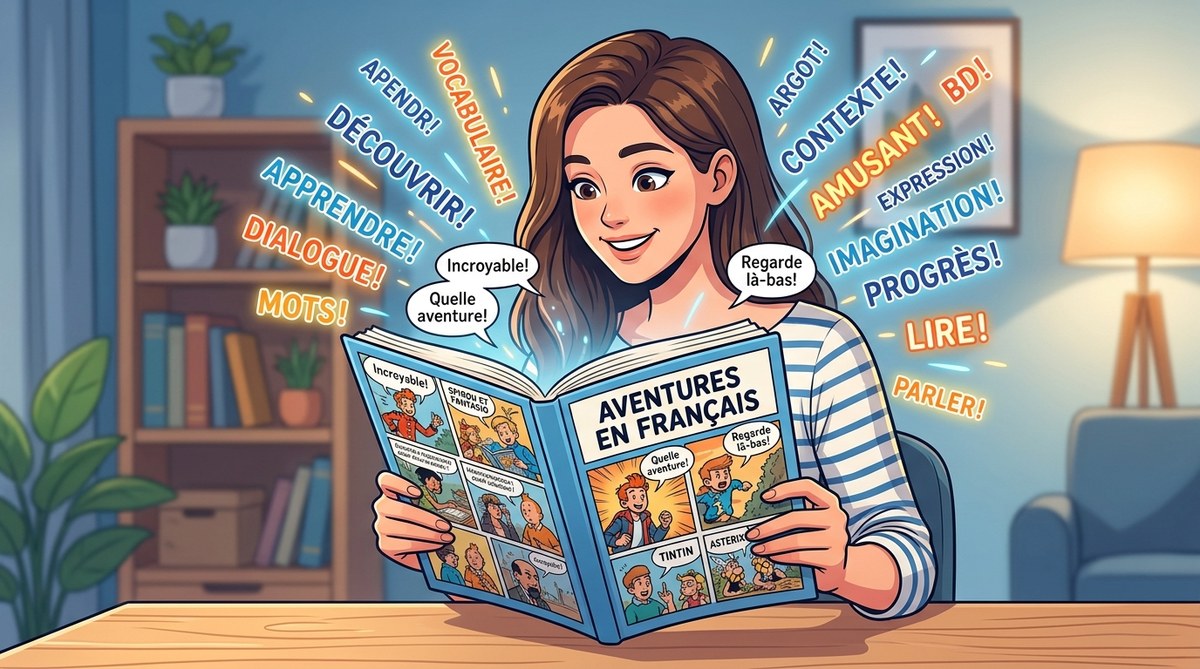
First, the pictures do the heavy lifting. When a character says “Il est furieux” while shaking a fist and turning red, you do not need a dictionary. The meaning sticks because you saw it. This is called visual scaffolding. Your brain connects the word to an image, which makes recall much stronger.
Second, the language is real. Comic dialogue mimics how people talk. You will find contractions, slang, interjections, and sentence fragments. These are the same patterns you hear in French movies and in conversations with native speakers. Textbooks teach you “Je ne sais pas.” Comics teach you “Chais pas” or “J’en sais rien.”
Third, comic books repeat vocabulary naturally. Characters use the same words for emotions, actions, and objects across many pages. This spaced repetition happens without you planning it. You see the word “cacher” (to hide) in one panel, then again three pages later. The repetition builds fluency.
The Core Vocabulary of French Comic Books
Every comic has a toolbox of words that appear again and again. If you learn these, you will understand most of the dialogue in any bande dessinée. Here are the categories you will encounter most often.
Sound and Action Words
French comics love onomatopoeia. These words are fun, weird, and essential. They also teach you how French speakers hear sounds differently than English speakers.
- Boum (boom)
- Paf (pow, or the sound of a slap)
- Vlan (wham)
- Splash (splash, but said with a French accent)
- Snif (sniff, used for crying)
- Glouglou (gulp gulp, the sound of drinking)
- Rrr (a growl, often used for anger or a motor)
These words are not just decoration. They teach you the rhythm and sound culture of French.
Common Verbs in Comic Dialogue
Comics use a lot of action verbs in the present tense. You will also see the passé composé and imparfait, but the present tense dominates because it makes the story feel immediate.
- Dire (to say) / Il dit (he says)
- Faire (to do/make) / Il fait (he does)
- Aller (to go) / On y va (let’s go)
- Voir (to see) / Tu vois (you see)
- Savoir (to know) / Je sais pas (I don’t know)
- Pouvoir (to be able to) / Je peux (I can)
- Vouloir (to want) / Je veux (I want)
Notice the contractions. “Je ne sais pas” becomes “Je sais pas” or even “Chais pas.” This is the spoken form.
Exclamations and Interjections
Characters in comics react loudly. These words are pure gold for sounding natural.
- Zut! (Darn!)
- Flûte! (Darn, literally “flute”)
- Mincedin! (a mild swear, like “gosh”)
- Sapristi! (Good heavens!)
- Ah bon? (Oh really?)
- Ben oui / Ben non (Well yes / Well no)
- Tiens! (Hey! or Here!)
Storytelling and Transition Words
Comics move the story along with simple connectors. You will see these on nearly every page.
- Puis (then)
- Ensuite (next)
- Soudain (suddenly)
- Alors (so / then)
- Donc (therefore)
- Voilà (there it is / that’s it)
- En fait (actually)
How to Read Your First French Comic
Starting a full comic in French can feel intimidating. Follow this numbered process to make it manageable.
- Pick the right series. Start with comics that use clear, standard French. Avoid comics with heavy slang or historical language at first. Good choices include Tintin, Astérix, Les Schtroumpfs (The Smurfs), and Lucky Luke. These use correct grammar and are widely available.
- Read a page without a dictionary. Look at the pictures first. Try to guess what each character is saying. Let the images tell you the story. This builds your inference skills.
- Read the same page with a dictionary. Look up the words you could not guess. Focus on the verbs and nouns that repeat. Do not look up every word. Only look up words that block your understanding of the plot.
- Write down 5 to 10 new words per session. Keep a small notebook or a digital list. Review this list before you read the next page. This is active learning.
- Read the page aloud. Comic dialogue is meant to be spoken. Read it out loud with emotion. This helps your pronunciation and makes the language feel more natural.
A Comparison of Learning Methods
Not all methods of learning French comic vocabulary are equal. Here is a table that shows common approaches and their effectiveness.
| Method | Time Investment | Vocabulary Retention | Best For |
|---|---|---|---|
| Reading only (no dictionary) | Low per page | Low to medium | Building confidence |
| Reading with dictionary lookup | Medium per page | Medium | Understanding plot |
| Reading + writing new words | Medium per page | High | Active vocabulary |
| Reading + writing + speaking aloud | High per page | Very high | Pronunciation and recall |
| Watching comic adaptations after reading | Low extra time | High | Connecting audio to text |
The most effective method combines reading, writing, and speaking. But even just reading with a dictionary is far better than not reading at all.
Common Mistakes and How to Avoid Them
Many learners make the same errors when they start reading French comics. Here are the most common ones and how to fix them.
- Looking up every word. This kills the fun and slows you down. You do not need to know every word. You need to understand the scene. Let some words remain a mystery. If they are important, they will repeat.
- Choosing a comic that is too hard. If you pick a comic with dense historical language or heavy dialect, you will get frustrated. Start with a series aimed at a general audience. You can always move to harder material later.
- Ignoring the images. Comic artists are storytellers too. The expressions, the backgrounds, the size of the speech bubbles all carry meaning. Use the images to decode the text.
- Not reading regularly. A comic once a month will not build vocabulary. Read for 15 minutes every day. Consistency matters more than volume.
“The best way to learn a language is to forget you are learning it. Comics let you get lost in a story. Your brain absorbs the words without fighting them.” — A note from a French teacher who uses bandes dessinées in class.
Building a Comic Reading Routine
To make real progress, you need a routine that fits your life. Here is a simple structure you can start today.
- Set a time. Read your comic at the same time each day. Morning coffee, lunch break, or right before bed.
- Set a goal. One page per day is enough. If you want to do more, great. But one page is a win.
- Track your words. Keep a list of the French comic books vocabulary you learn. Review it once a week.
- Mix media. After you read a few pages, find a short video or audio clip of the same story. Some comics have animated adaptations. Hearing the words helps lock them in.
What to Do When You Get Stuck
Every learner hits a wall. The dialogue feels too fast. The vocabulary is unfamiliar. The story stops making sense. Here are three ways to push through.
- Reread the same page. The second read is always easier. You already know the context.
- Skip that page and come back. Sometimes your brain needs a break. Move to the next page. The story might become clear again.
- Use a different comic. If one series is not working, switch to another. Maybe you need a different art style or a more modern story. Try Les Vieux Fourneaux (a comic about older people with modern French) or L’Arabe du futur (a memoir comic with clear language).
The Vocabulary You Will Actually Use
Here is a bulleted list of French comic books vocabulary that appears in almost every bande dessinée. Learn these, and you will understand 80 percent of the dialogue in a typical comic.
- Regarde! (Look!)
- Attends (Wait)
- Viens (Come)
- Va-t’en! (Go away!)
- Laisse tomber (Forget it / Let it go)
- C’est pas vrai (That’s not true / No way)
- T’as raison (You’re right)
- T’as tort (You’re wrong)
- J’arrive (I’m coming)
- On se calme (Calm down)
- Fais gaffe (Watch out / Be careful)
- C’est nul (That’s lame)
- C’est génial (That’s great)
- J’en ai marre (I’m fed up)
- Ça y est (That’s it / It’s done)
These phrases are not just for comics. You will hear them in French restaurants, on the street, and in conversations with friends.
How This Fits Into Your Overall Learning
Reading French comics is one piece of a larger plan. To build a strong vocabulary, you also need to practice other skills. For example, you can work on mastering common French verb conjugations for beginners to recognize the verbs you see in speech bubbles. You can also build French vocabulary naturally through daily practice by combining comic reading with other methods.
If you want to sound more like a native, pay attention to the idioms in comics. Many bandes dessinées are full of them. Learning 10 essential French idioms to sound like a native speaker will help you understand the jokes and cultural references that make comics so fun.
And if you ever feel stuck on a grammar point that keeps appearing in your comic, you can look it up in a guide like 5 French grammar rules that every learner must know. But do not let grammar stop your reading flow. Save the deep grammar study for later.
Your Next Step: Pick a Comic and Start
You do not need to wait until your French is perfect. You do not need to know every verb tense. You just need a comic, a notebook, and 15 minutes today.
Go to a library, a bookstore, or an online retailer. Find a copy of Tintin en Amérique or Astérix le Gaulois. Open to page one. Look at the pictures. Read the first speech bubble. If you do not know a word, guess from the image. If you still do not know, look it up. Write it down. Then read the next bubble.
This is how you build French comic books vocabulary. One panel at a time. One page at a time. One story at a time.
Before you know it, you will be flipping through a bande dessinée without reaching for a dictionary. You will be laughing at the jokes. You will be thinking in French. And you will wonder why you did not start sooner.