 paisley
You can hold a decent conversation in French. You understand the gist of a news article. But when you sit down to write an email or a short paragraph, your sentences come out clunky. Agreement mistakes creep in. You forget the subjonctif. Your vocabulary feels limited to simple words. You are not alone. Writing is often the last skill to catch up, because it forces you to produce the language without the crutch of tone or gestures. The good news is that with the right approach, you can improve French writing skills faster than you think.
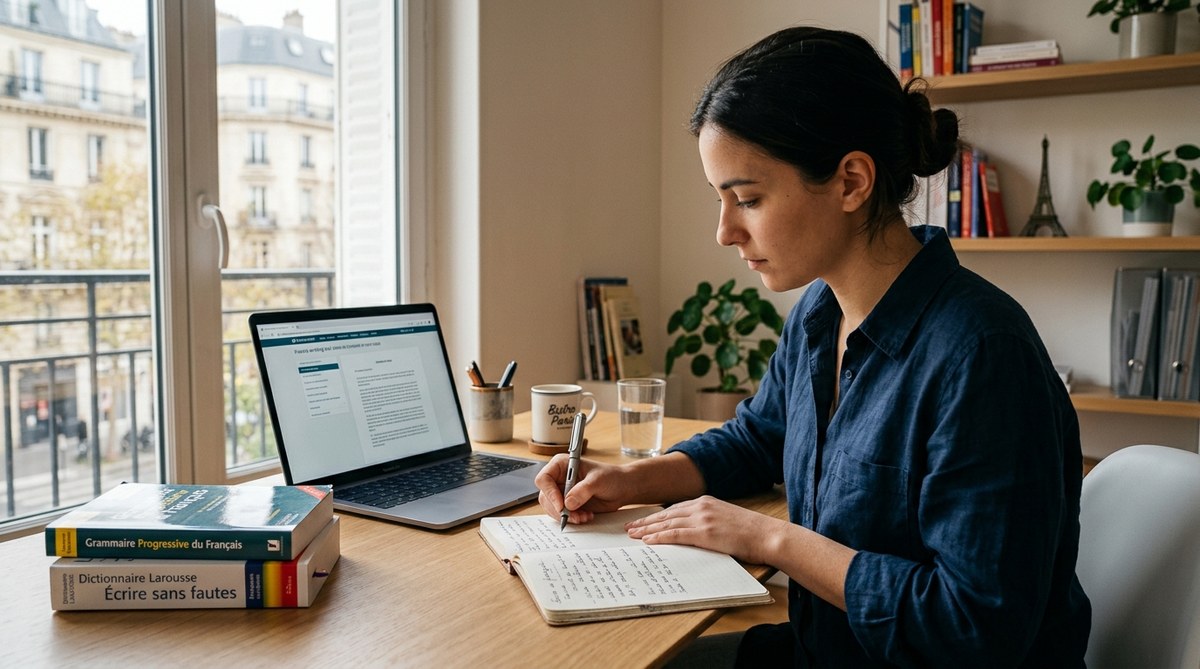
Improving your French writing skills does not require endless grammar drills. The fastest path combines daily practice with targeted feedback. By writing a few sentences every day, using tools that catch your specific mistakes, and actively rewriting your work, you build muscle memory for correct structures. This guide gives you a clear process, common pitfalls to avoid, and a practical toolkit to see real progress in weeks, not months.
Why Writing in French Feels Like a Separate Language
Speaking and writing use different mental pathways. When you speak, you can rely on fillers, repetition, and facial expressions. Writing demands exact word choice, correct spelling, and proper punctuation. The gap between your spoken ability and your written ability can feel huge. That is normal. The solution is to treat writing as a specific skill you train, not a side effect of speaking practice. Focused effort on writing will also improve your grammar and vocabulary for real.
The Four Step Writing Routine That Works
I have seen this routine help intermediate learners move from hesitant to confident in a matter of months. It is simple and repeatable.
- Write for ten minutes without stopping. Pick a topic you care about. Your weekend, a movie you watched, a plan for next week. Do not worry about mistakes. Just get the words down.
- Run your text through a grammar checker that explains errors. Tools like Bon Patron, LanguageTool, or the Premium version of Kwiziq will flag issues and give you a short lesson. Read the explanation and try to understand why you made the error.
- Rewrite the corrected version by hand. This step locks the correct form into your muscle memory. Do not just copy. Read each sentence, think about the correction, then write it.
- Read your rewritten paragraph aloud. You will hear awkward phrasing and rhythm problems that your eyes miss. If a sentence sounds strange, reword it.
Repeat this cycle five days a week. In 2026, there is no excuse not to do it. Use a notebook or a simple text app. The key is consistency, not length.
Watch Out for These Common Writing Mistakes
Here are the errors that show up again and again at the intermediate level. Knowing them will help you spot them in your own work.
- False friends: words like actuellement (currently, not actually) and sensible (sensitive, not sensible).
- Gender agreement: forgetting to match adjectives to nouns. Une belle maison is correct, but un belle maison is not.
- Verb tense mixing: starting a story in passé composé and then sliding into imparfait without reason.
- Subject omission or doubling: writing Mange une pomme instead of Je mange une pomme.
- Accent errors: leaving off accents on être or confusing ou and où.
Awareness is half the battle. The other half is systematic practice with a feedback loop.
Techniques and Common Mistakes Side by Side
| Technique | Why It Helps | Mistake It Targets |
|---|---|---|
| Daily dictation (listen and write) | Improves listening and spelling simultaneously | Homophones (verre/vers/vert) |
| Paragraph rewriting after correction | Locks in correct grammar patterns | Serial agreement errors |
| Using a word bank from your reading | Expands active vocabulary | Repeating the same 50 words |
| Self recording and transcription | Exposes pronunciation/spelling gaps | Silent letters and liaison |
Build Your Own Feedback Loop
“The best way to improve writing is to write something every day, then get it corrected. Without correction, you just reinforce your mistakes.”
French Professor (source: frenchprofessor.org)
Feedback can come from a tutor, a language exchange partner, or an AI tool designed for learners. The important thing is that you receive explanations, not just a red mark. If you use a tool, make sure it offers a breakdown of each error. For grammar rules, you can also review essential French grammar rules every beginner should know to strengthen your foundation.
A Simple Weekly Writing Plan
You do not need to spend hours. Here is a realistic schedule that fits into a busy week.
- Monday: Write a 100 word journal entry about your weekend.
- Tuesday: Use a grammar checker to correct it. Rewrite the corrected version.
- Wednesday: Read a short article or story in French (news or a blog). Pick five new words and write example sentences with them.
- Thursday: Write an email to a friend in French (real or imaginary). Keep it natural.
- Friday: Do a timed dictation. Find a two minute audio clip (podcast with transcript works best). Listen and write. Check against transcript.
- Saturday: Free write on a prompt. No editing. Just get words on paper.
- Sunday: Rest or review any corrections from the week.
This plan targets all aspects of writing: generation, correction, vocabulary building, and listening/spelling connection. Over a month, you will notice fewer errors and more natural phrasing.
Why Reading Also Makes You a Better Writer
You cannot write well in a language you do not read. Reading exposes you to sentence structures, idioms, and correct spelling in context. Make it a habit to read something in French every day. It does not have to be long. One short news article or a page of a novel will do. Pay attention to how sentences are built. Notice connectives like cependant, en revanche, par consequent. Add them to your own writing.
If you want to expand your vocabulary further, check out how to build French vocabulary naturally through daily practice. It pairs perfectly with a writing routine.
A Note on Motivation and Plateaus
Progress in writing is not always linear. Some weeks you will feel stuck. Your sentences may still feel basic. That is the moment to double down, not give up. Look back at what you wrote a month ago. You will see improvement even if it does not feel like it day to day. Celebrate small wins: a correctly used subjonctif, a new connector, a paragraph with zero accent errors.
Your Turn: Start Today
You already have the foundation. Now you need to turn it into a daily habit. Pick one technique from this guide and use it for the next week. Maybe it is the four step routine. Maybe it is the weekly plan. Whatever you choose, stay consistent. In two months, you will look back and see a clear difference in your written French. You will write with more confidence, fewer mistakes, and a voice that sounds more like you.
And when you are ready to tackle other skills, explore effective strategies to improve your French listening skills fast. All the skills support each other. Keep going. You have got this.